
L-Shaped vs U-Shaped vs Corner Sofa: Which Is Best?

A large sofa can transform your living room, but choosing the wrong shape can waste space or make the room feel crowded. L-shaped, U-shaped and corner sofas are three of the most popular options in Dubai homes, and each one suits a different room size and lifestyle. In this guide, we compare them side by side so you can see how they differ in seating, space needs and style. By the end this blog, you’ll know which one fits your room, your family and your budget.
L-Shaped vs Corner Sofa: Are They the Same Thing?
In everyday use, the two names often describe the same type of sofa, so the confusion is understandable. Both are made of two sections that meet at a right angle, and both are designed to sit against two walls. The difference usually comes down to design. An L-shaped sofa typically has one long side and a shorter side, often finished with a chaise for stretching out. A corner sofa is built around the corner itself, often with a dedicated corner seat and two sides of similar length, and it is commonly made in modular pieces. Many stores use the terms interchangeably, so always check the dimensions and layout of the specific sofa before you order.
Quick Comparison Table
Not sure where to start? This table compares the three sofa shapes at a glance. The sections that follow explain each one in more detail.
| Feature | L-Shaped Sofa | U-Shaped Sofa | Corner Sofa |
|---|---|---|---|
| Typical seating | 4–6 people | 6–9 people | 4–7 people |
| Typical size | 250–300 cm per side | 300–400 cm across | 240–320 cm per side |
| Best room size | Small to medium | Large | Medium |
| Floor space needed | Moderate | High | Moderate |
| Layout style | Long side with a chaise or shorter side | Three sections wrapping a central space | Built around a corner seat |
| Best for | Everyday family use and apartments | Hosting, movie nights and big families | Making use of an empty corner |
| Budget level | Lower to mid-range | Mid-range to premium | Mid-range |
Quick takeaway: Choose an L-shaped sofa for flexibility, a U-shaped sofa for maximum seating, and a corner sofa to make the most of a tight corner.
L-Shaped Sofa: Space-Saving Comfort for Everyday Living
An L-shaped sofa is made of one long section joined to a shorter one, forming an “L” that sits neatly against two walls. It is one of the most practical layouts for Dubai homes because it gives you plenty of seating without taking over the whole room. Many designs include a chaise, so you can stretch out and relax while the rest of the family sits beside you. The open side also keeps the room feeling more spacious than a bulkier sectional would. You can choose a left-hand or right-hand layout, depending on where your walls, doors and TV are placed. The main drawback is that the seating faces one direction, so it is less sociable than a U-shaped sofa for large gatherings. It works best in small to medium living rooms and in families of three to five people.
U-Shaped Sofa: Maximum Seating for Large Rooms and Big Families
A U-shaped sofa is made of three connected sections that wrap around a central space, usually where the coffee table sits. It offers the highest seating capacity of the three layouts, which makes it ideal for large families and homes that host often. The shape also faces everyone toward each other, so it is great for conversation, movie nights and family gatherings. Many designs include a chaise or extra lounging section, so several people can stretch out at once. Because it needs a lot of floor space, it works best in large living rooms, villas and majlis-style spaces rather than compact apartments. It also sits at the higher end of the price range, since it uses more material and a larger frame. Before you order, measure your room carefully and check that the sections can fit through your doors and lift.
Curved Sofa: A Soft, Stylish Statement for Modern Spaces
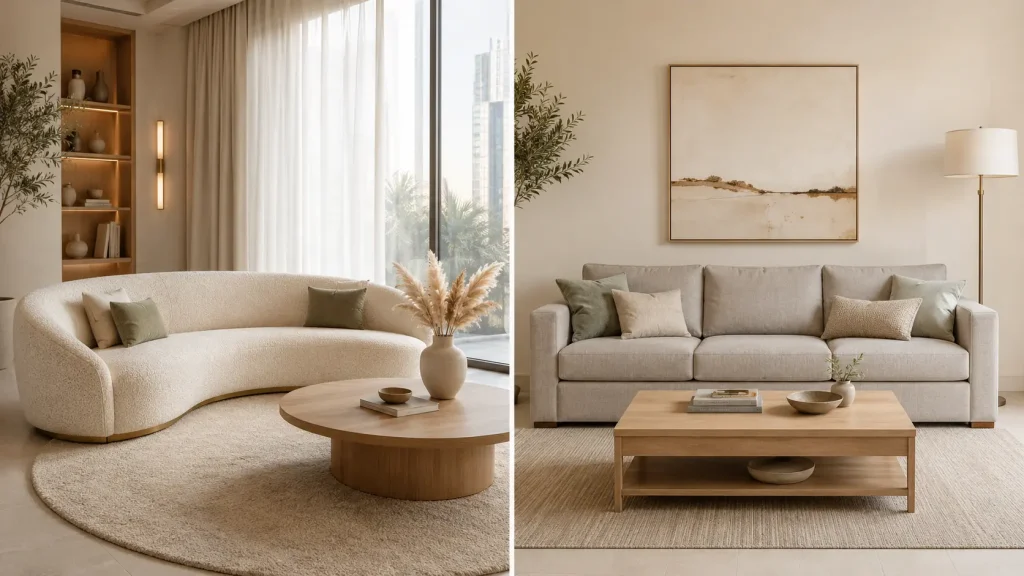
A curved sofa Dubai replaces sharp corners with smooth, rounded lines, giving the living room a softer and more elegant look. It has become a popular choice in modern Dubai homes because it works as a design feature as well as seating. The curve also encourages conversation, since everyone faces the center of the sofa. Many designs come in bouclé, velvet or chenille, which add to the cozy, luxurious feel. Curved sofas look best in open spaces where they can sit away from the walls, such as in the middle of a large living room or in front of a window. They take up more floor space than a straight sofa, and they can be harder to fit into narrow rooms or tight corners.
How to Choose the Right Shape for Your Room
The best sofa shape depends on your space, your household and the way you use your living room. Work through the five points below and the right choice should become clear.
Match the Sofa to Your Room Size
Room size is the first thing to settle, because a sofa that is too large makes the whole space feel cramped. In a studio or small apartment, a compact L-shaped sofa or a small corner sofa works best, as both use two walls without blocking the room. In a standard apartment, an L-shaped or corner sofa gives you plenty of seating while leaving space to move around. If you have a villa or a large living room, a U-shaped sofa suits the space well, and a curved sofa also looks great if you have room to place it away from the walls. As a general rule, the sofa should take up no more than about half of the room’s floor space.
Consider How Many People Use the Sofa
Think about who sits on the sofa every day, not just on special occasions. For a family of three to five, an L-shaped or corner sofa usually gives enough seating. If you have a larger household, or several people often sit together, a U-shaped sofa offers more room for everyone. If you only host guests now and then, you can choose a smaller sofa and add extra seating, like an armchair or pouf, when needed.
Think About Your Lifestyle
Your daily habits should shape the choice as much as your floor plan does. If you host often, a U-shaped sofa keeps everyone facing each other, which makes conversation easier. For movie nights, an L-shaped sofa with a chaise gives you a comfortable spot to stretch out. If you have kids or pets, pick a durable, stain-resistant fabric and a sofa with deep, forgiving cushions. And if you sometimes work from the sofa, choose a firmer seat with good back support.
Check Your Room’s Layout
Look at the room itself before you fall in love with a shape. In an open-plan home, an L-shaped sofa can divide the living area from the dining area without needing a wall. In an enclosed room, a corner sofa often makes the best use of the space. Check where your doors, windows and TV are placed, and make sure the sofa won’t block them. Keep the sofa clear of AC vents and units, since blocked airflow makes the room less comfortable and can also affect the fabric over time.
Plan Your Walking Space
A sofa needs breathing room, so leave enough space to move around it comfortably. As a general guideline, keep about 75 to 90 cm of clearance for main walkways, and around 45 cm between the sofa and the coffee table. These figures are only a rough guide, and the right gap depends on your room and your habits. A simple test is to mark the sofa’s footprint on the floor with masking tape and walk around it before you order.
How to Measure Before You Order
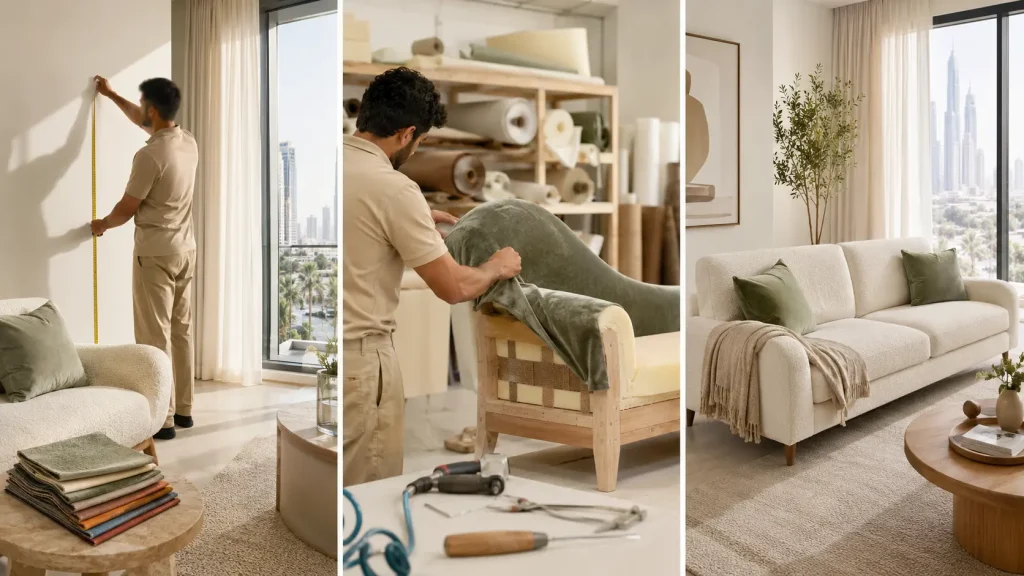
Measuring takes a few minutes and can save you from an expensive mistake. Start by measuring the wall length and depth where the sofa will sit, then note any windows, sockets or AC units nearby. Next, mark the sofa’s footprint on the floor with masking tape and walk around it to see how the space feels. Just as important, measure the delivery path, including doorways, corridors, stairwells and lifts, because large sectionals can be hard to move in apartment buildings. Write down all measurements and compare them against the sofa’s full dimensions, including the depth and height. If you want help, our team offers a free visit and measurement so you can order with confidence.
Best Fabrics for Large Sofas in Dubai
Large sofas get heavy daily use, so the fabric matters as much as the shape. Chenille and microfiber are popular choices for families, as they are soft, durable and easy to maintain. Velvet adds a luxurious look, and modern performance velvets resist wear better than many people expect. Bouclé gives a cozy, textured feel that suits curved and modern designs, while leather and faux leather are easy to wipe clean and handle heat well. If you have kids or pets, choose stain-resistant or water-repellent options, and pick mid-tones that hide marks better than very light or very dark shades. Our custom sofas also come with a range of fabrics rated for heavy use, so you can match the material to your lifestyle.
Conclusion
L-shaped, U-shaped and corner sofas each suit a different space and lifestyle. An L-shaped sofa offers flexible, space-saving comfort, a U-shaped sofa gives maximum seating for large rooms, and a corner sofa makes smart use of an empty corner. The best choice comes down to your room size, your household and how you use your living room. Measure carefully, plan your walking space, and pick a fabric that matches your daily routine.
Frequently Asked Questions
What is the difference between an L-shaped sofa and a corner sofa?
The two terms are often used for the same type of sofa, but there is a small difference in design. An L-shaped sofa usually has one long side and one shorter side, often with a chaise. A corner sofa is built around the corner itself, with a dedicated corner seat and two sides of similar length. Always check the dimensions of the specific sofa before ordering.
Which is better for a small living room: an L-shaped or corner sofa?
Both work well in small rooms because they use two walls and leave the center open. An L-shaped sofa is usually more flexible, since you can choose a left- or right-hand layout and often a more compact size. A corner sofa is a good choice if you want to make use of an empty corner. Measure your room first and choose the one that leaves enough space to walk around comfortably.
How much space do I need for a U-shaped sofa?
A U-shaped sofa needs a large living room, as it wraps around a central space and often measures 300 to 400 cm across. You also need enough room for a coffee table and clear walkways around the sofa. As a general guideline, leave about 75 to 90 cm for main walkways. If your room is small, an L-shaped or corner sofa is a better fit.
How many people can sit on an L-shaped sofa?
Most L-shaped sofas seat four to six people, depending on the size and whether it includes a chaise. The chaise section is great for stretching out, but it usually seats fewer people than a standard seat. For exact seating, check the dimensions of the specific model or request a custom size to suit your household.
Can I get a sofa made to fit my room’s exact size?
Yes. With a custom sofa, you can choose the exact dimensions, layout, seat depth, fabric and color to suit your space. This is especially useful for rooms with unusual shapes, narrow entryways or specific wall lengths. At Dubai Sofa, our team offers a free visit and measurement, then helps you finalize the design before production begins.
Related News


Submit comment